

 By Tamara Sims, Department of Psychology, Stanford University, Building
420, Jordan Hall, Stanford, CA 94305
How people interpret and respond to negative feelings (e.g., Boiger, Mesquita, Uchida, & Barrett, 2013; Diener & Suh, 2000; Matsumoto, 1993; Mesquita & Leu,
2007). Such culture-specific understandings of the nature and source of emotion can have powerful implications for mental and physical well-being. Indeed, multiple
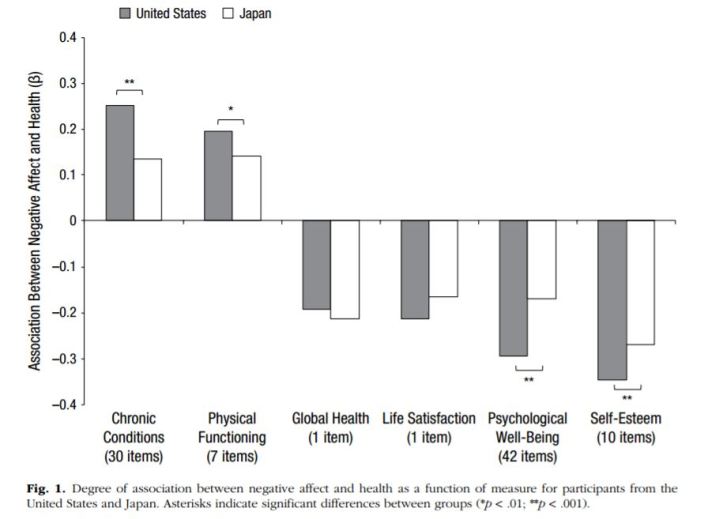
studies have shown considerable divergence across cultures in the degree to which negative affect influences physiological and psychological functioning (e.g.,
Consedine, Magai, Cohen, & Gillespie, 2002; Diener &
Suh, 2000; Mauss & Butler, 2010; Miyamoto et al., 2013;
Soto, Perez, Kim, Lee, & Minnick, 2011).
The theoretical case for expecting cultural variation in the health consequences of negative emotions is particularly strong for the comparison between European
American and East Asian cultural contexts.
The concept of negative feelings in the United States is grounded in
Western philosophical assumptions as well as in a set of historically derived and selected ideas and…
View original post 1,296 more words
 Health Concierge. Telemedicine. Personalized Diet Plan